
Improving your firm’s local search presence starts with three things: your Google Business Profile, client reviews, and local content. Together, they help Google understand where you’re based, what you offer, and whether your firm is a relevant result for local searches.
Sounds simple enough, but immigration law comes with a few challenges that many local SEO guides don’t account for. For example, potential clients often search for specific visa types, family matters, or citizenship questions. That’s why strategies that work well for a café or plumber don’t always translate to an immigration practice.
At Matter Solutions, we’ve worked with enough immigration firms to see where these gaps show up and how much difference it makes once they’re fixed. This guide walks through each area step by step.
But before diving into the fixes, let’s look at what actually drives local visibility for immigration law firms in the first place.
What Drives Local Visibility for Immigration Law Firms
Local search rankings depend on a handful of signals and Google looks at these before deciding which firms to show first. That includes your:
- Google Business Profile
- Consistent business information across the web
- Positive client reviews
Your website also needs content that clearly speaks to local searchers.

Those signals carry extra weight for immigration firms because the searches themselves are often much more specific. Someone searching for an immigration lawyer is usually looking for something more specific than the nearest office.
They might need help with an H-1B renewal, a green card interview, or a deportation defense. So, of course, they’ll want a firm that handles that exact situation in their area. That’s why successful immigration lawyer marketing starts with understanding how potential clients search.
Your Google Business Profile Is the Foundation
Before anything else, your Google Business Profile needs to be set right. After all, this is the listing that shows up on both Google Maps and in local search results.
And for most law firms, it’s the first real impression a potential client gets. To get it working in your favor, you need to focus on three things: completeness, consistency, and the citations that back it up.
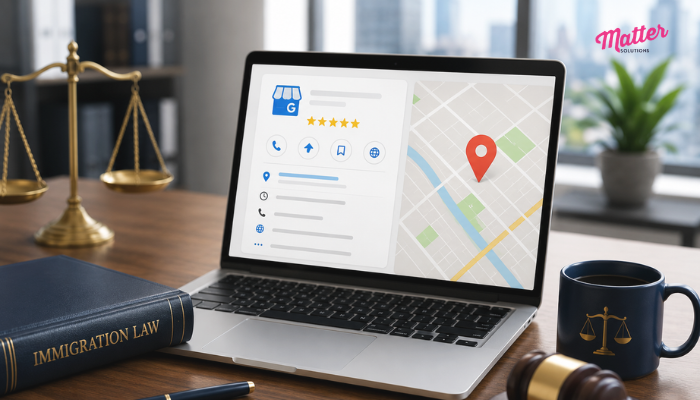
Here’s what each one involves.
Complete Every Important Profile Detail
Start by filling in every field your Google Business Profile allows, including your services, service area, opening hours, and the languages your team speaks.
Language is especially important for immigration firms, since many clients search in their native language or specifically look for someone who can speak it. Without that information, you’re making it harder for Google and potential clients to connect you with those searches.
Don’t treat your profile as a one-time task, either. Small changes like updated hours, new photos, or occasional posts help keep it active. More importantly, it signals that your firm is still engaged and available, which can influence whether someone decides to contact your firm.
Keep Your Name, Address, and Phone Number Consistent
Google cross-checks your business details against other places they appear online, like your website footer, your social media pages, and legal directories. This is often called NAP consistency, short for Name, Address, and Phone Number.
If your firm is listed as “Smith Immigration Law” on one site and “Smith Immigration Law Firm LLC” on another, Google treats that as a mismatch. It doesn’t break anything outright, but it can dilute confidence in your listing and hold back your rankings.
You can prevent these issues by auditing your listings and correcting any inconsistent name, address, or phone number details. It’s tedious work, but it removes one of the most common reasons local rankings stall.
Build Citations on Trusted Legal and Local Directories
A citation is simply any place online that mentions your firm’s name, address, and phone number, even without a link. Think of them as references other websites give about your business. Just like a judge trusts a witness backed up by multiple sources, Google relies on citations to confirm that your business exists where you say it does.
That said, not all citations carry the same weight. For example, law-specific directories like Avvo, FindLaw, and Justia tend to carry more authority than generic business listing sites.
In the legal space, these platforms are more trusted sources of information, so Google treats them as stronger signals when confirming a firm’s legitimacy.
Earn and Respond to Client Reviews
Reviews are one of the strongest trust signals in local search. Unlike anything a firm says about itself, they reflect real experiences from past clients that both Google and potential clients can evaluate.
Plus, reviews are even more important in immigration cases because clients are often making a deeply personal, high-stakes decision.
To build a steady, ethical flow of reviews, try the following:
- Ask at the Right Time: The best moment to ask for a review is right after a successful outcome, when the client’s relief and gratitude are still fresh. And you don’t need to call them or write a lengthy message. Just send a short email with a subject line like “Could you share your experience?” and keep it simple.
- Make It Easy to Leave a Review: The fewer steps a client has to take, the more likely they are to follow through. Send a direct link to your Google review page so they can leave feedback without creating an account or navigating multiple pages.
- Respond to Every Review: Responding to reviews, both positive and negative, shows prospective clients that your firm is attentive and accountable. In fact, a short, professional response to a negative review can build more trust than a string of five-star ratings with no replies.
Keep in mind that review requests should always respect client confidentiality, especially given the sensitive nature of immigration matters. A general request for feedback works better here than anything that references case specifics.
Location-Specific Content Brings in Local Clients
Once your profile and reviews are solid, content is what extends your visibility beyond your immediate listing.
To see the difference, compare these two pages. One says, “We handle immigration cases.” The other explains how your firm helps clients navigate the local USCIS office or supports Spanish-speaking families through the green card process. Google can do a lot more with the second page, and so can the person reading it.
Building that level of specificity includes creating a dedicated page for each city or region your firm serves. Each page should reflect the needs and search habits of that community. Someone looking for deportation defense in Dallas searches differently from someone seeking a green card in Houston. That’s the kind of local relevance that helps your content get found.
Your site should also answer the questions immigration clients ask before they contact anyone. Blog posts are one of the best ways to do that. Topics like visa timelines, green card interviews, and work permit renewals attract people who are close to making a decision.
Over time, that content builds trust and turns searches into consultations.
Is Your Local SEO Actually Working?
Frankly, it depends on what your data is telling you. Most firms don’t check until something feels off, but the numbers worth watching are easy to find once you know where to look. These three tools give you the clearest picture:
- Google Business Profile Insights: This is where you see how your listing is performing, including how people find you, what they search, and what actions they take. If you’ve been optimizing your profile for a few months and those numbers haven’t moved, the profile itself likely needs more work.
- Google Search Console: Search Console tracks the queries that drive traffic to your site and shows whether your location pages and blog content are appearing in search results. That makes it more useful than most ranking estimates, which offer a broad average rather than data tied to your specific website.
- Google Analytics: Rankings tell you who found you, but Analytics tells you what they did next. It shows which pages attract organic traffic, how long visitors stay, and where prospective clients drop off before making contact.
When used consistently, these tools help you identify where you’re losing visibility in local search before it affects your caseload. We’ve seen firms recover around 20–30% of missed local inquiries simply by acting on issues flagged in Google Business Profile Insights and Search Console.
Build Your Local Presence One Step at a Time
A lot of immigration attorneys assume that doing great legal work is enough to bring in clients on its own. But for most people today, local search is the first place they look for an attorney. A firm that isn’t visible there is missing the first conversation most clients have before they ever contact anyone.
This guide covered the factors that influence local rankings for immigration attorneys. That includes a complete Google Business Profile, client reviews, location-specific content, and a simple way to track your progress.
And if you’d rather focus on your cases, Matter Solutions can handle the local SEO strategy and execution. Reach out, and we’re happy to talk through what that could look like for your practice.

Check out: https://kassetaua.com/ – всегда нахожу то, что ищу. [jftv]