
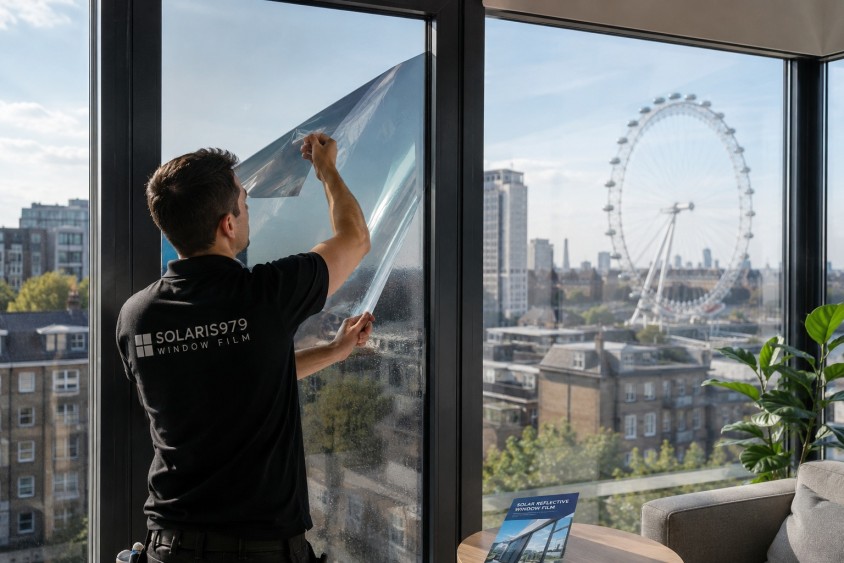
Solar reflective film in the United Kingdom is a subject that tends to invite scepticism. “We barely get any proper sun – what’s the point of film?” is a typical comment on MoneySavingExpert, where using solar control window film is dismissed as a waste of money. And there is a logic to it: London receives roughly half as many sunshine hours as Madrid.
But overheating statistics tell a different story. According to the Building Research Establishment, more than 20% of British homes overheat in summer. As the climate changes, that figure grows every year, and support for solar window film is growing with it.
The heatwave of 2022, when temperatures in the United Kingdom exceeded 40°C for the first time on record, brought the problem into sharp focus.
The problem with British homes is not the amount of sunshine, but their inability to cope with heat. Homes in the UK were built to retain warmth:
- thick walls,
- small windows,
- good insulation.
Modern developments, however, have taken a different path – large windows, panoramic glazing, open-plan layouts. These homes absorb heat quickly and release it slowly. Solar reflective film on south- and west-facing windows can reduce heat gain by 50–70%, which in the British context is often enough to maintain comfort without air conditioning. Depending on the model, these tinting solutions, including solar reflective window film https://www.window-film-solaris.co.uk/window-film/solar , can block up to 80% of sunlight and reflect up to 90% of solar heat penetrating through the glass.
Positive reviews from the forums
Users on MoneySavingExpert share real-world experience. One fitted solar reflective film to the windows of a south-facing bedroom in Birmingham. The result: the room temperature on a hot July day dropped from 32°C to 26°C. “I can finally sleep with the windows closed,” he wrote. Another user from London covered a loft conversion: it had been reaching 36°C in summer, and came down to 28°C. A difference of 8°C is the difference between a sauna and a liveable room.
Solar reflective film – features of the British market
Solar reflective film is less widespread in the United Kingdom than in the United States or southern Europe. This means fewer installers and higher prices. Professional installation costs £15–35 per square metre – more than in the US. But the choice of quality products is limited to established brands:
- 3M,
- LLumar,
- Solar Gard,
- Bruxsafol.
- Kraft Films
- Solaris979
Plenty of cheap film is sold on Amazon.co.uk – but as TintDude users warn, budget options tend to bubble and cloud within one to two years.
British planning rules do not generally require consent for internal installation of solar window film. However, in Grade I or Grade II listed buildings, any alterations may require permission. In conservation areas, highly reflective mirror-finish solar window films can sometimes attract objections.
Neutral films with a VLT above 45% typically pass unnoticed – they are virtually invisible from outside and do not alter the character of the façade.
The winter question: heat loss through film
The principal objection to solar reflective film in the UK is winter heat loss. The British heating season runs for six to seven months, and free solar gain through windows is a meaningful contribution to home warmth. Film reflects a portion of that heat back outside. According to energy consultants on haustechnikdialog.de, losses amount to 15–25% of solar heat gain through treated windows. For a typical British home, this may translate to an additional £50–£120 per year on heating bills.
Yet for most south-facing windows, the annual balance remains positive. Savings on cooling (even if that means simply running fans) and protection of furnishings from fading outweigh the winter losses. A MoneySavingExpert user from Bristol conducted a year-long experiment: film on south-facing windows, with temperature and bill measurements over 12 months. The outcome: £140 saved on electricity in summer (fans and a portable air conditioner), £65 extra spent on gas in winter. Net saving – £75 per year, plus a significant improvement in comfort.
Solar reflective film for British offices
For commercial buildings, the case is more clear-cut. Offices with full-height glazing overheat even in the British climate – internal heat from computers, people, and lighting combines with solar heat gain. Solar reflective film for windows reduces the load on air-conditioning systems by 25–40%, and at the cost of commercial cooling that pays back within one to two years. For office buildings in London, Birmingham, and Manchester, this is a standard measure adopted widely by property management companies.
New-build properties in the UK represent a particular category of risk. Developers install large windows for marketing purposes: “bright, spacious apartments.” But they are sold in winter, when overheating goes unnoticed. The first summer comes as a shock: a top-floor flat with south-facing glazing can reach 35°C. On MoneySavingExpert, this is one of the most frequent complaints from new-build buyers. Solar reflective film is the quickest solution – it requires no consent from the management company and does not void the window warranty when correctly specified.
Public buildings
Schools and hospitals in the United Kingdom are also active users of solar reflective film. Hospital wards with south-facing glazing overheat critically – for patients, this is not merely discomfort but a clinical risk. The NHS has published guidance on tackling hospital overheating, and solar control film is listed as one of the priority measures. The cost is modest compared with air-conditioning systems, installation does not disrupt ward operations, and the effect is felt immediately.
For landlords, solar reflective film is also a way to increase the appeal of a property. Tenants are paying growing attention to comfort during the warmer months. A flat with film on south-facing windows that does not overheat in summer lets faster and at a higher rent. There is also the benefit of an improved EPC rating, which affects the minimum requirements for letting – from April 2025, the minimum rating for new tenancies has been raised.
Prospects for solar control films
Climate forecasts for the UK also favour solar reflective film. The Met Office warns that by 2050, summer temperatures in southern England will rise by 3–5°C. Heatwaves that currently occur once a decade will become the norm every summer. Investing in solar control film today is preparation for the climate of tomorrow. With a service life of 15–20 years, film installed in 2026 will still be working into the 2040s, by which time overheating will be a standard problem for the majority of British homes.
Solar control films – types and characteristics
Solar control films form a broad category encompassing reflective, neutral, and sputtered films. For the British climate, the choice has its own requirements: a balance between summer heat protection and minimal winter losses. Unlike southern countries, where maximum heat rejection is the priority, in the UK it is important to preserve as much natural light as possible. Films with a high VLT (40–60%) and a moderate SHGC (0.30–0.40) are therefore the optimal choice.
- Reflective solar control films (Silver, Stainless Steel) – maximum heat rejection, daytime privacy, but visible mirror effect from outside and some attenuation of Wi-Fi signals. For private homes in the UK, this is often too aggressive.
- Neutral films (Neutral, Low-E) – less conspicuous, no effect on Wi-Fi, but more modest thermal performance.
- Sputtered films – the middle ground: good performance, minimal visibility, moderate effect on signals. For a typical British home, a sputtered solar control window film is the best choice.
Performance parameters worth checking when selecting solar control films for the UK:
- SHGC 0.25–0.40 (not so aggressive as to cause excessive heat loss in winter),
- VLT 40–55% (sufficient light on overcast days),
- UV blocking 99% (standard for all professional-grade films),
- LSG (Light-to-Solar Gain) – the higher the better: an LSG of 1.3 or above means the film transmits more light than heat.
Installation: DIY or professional
The market for professional solar control film installers in the UK is less developed than in the United States. Finding a qualified fitter in a major city is straightforward, but in rural areas the choice is limited. Professional installation costs £15–35 per m². DIY film from professional brands costs £8–20 per m². Many MoneySavingExpert users report successful DIY installation on standard windows. For panoramic or roof windows, they recommend a professional. The golden rule: perfectly clean glass before installation and minimal dust in the room.
Subsidies and tax relief in the UK
Unlike Germany, where the BAFA programme subsidises up to 20% of the cost of solar protection improvements, there are no direct subsidies for solar window tint in the United Kingdom. However, for commercial buildings, expenditure on solar control film may be written off as an energy efficiency improvement under the Enhanced Capital Allowances scheme. For residential properties, film can improve an EPC (Energy Performance Certificate) rating, which affects property value at the point of sale or letting.
Practical conclusions on solar control films
A topic deserving separate mention is solar control films for conservatories. In the UK, conservatories are extraordinarily popular, but their main problem is overheating from May to September. A fully glazed structure functions like a greenhouse. Film on the roof and walls of a conservatory reduces temperature by 8–15°C, transforming it from a seasonal space into a year-round room. On MoneySavingExpert, this is one of the most common reasons for installation – and one of the cases where the effect is most striking.
Solar control films in the British climate are not about surviving extreme heat – they are about comfort and practicality. For south- and west-facing windows, film is justified in the great majority of cases: three to five sweltering weeks a year become manageable rather than miserable, furniture does not fade, and air conditioning is either unnecessary or runs minimally. For north-facing windows, film is not needed. For loft conversions and upper floors, it is almost essential. Choose sputtered or neutral films with a VLT of 40–55%, apply to south-facing windows, and the difference will be apparent from the very first sunny day.
Comparison with alternatives: external awnings are more effective (blocking up to 90% of heat) but cost £500–£2,000 per window and may not be permitted in conservation areas. Air conditioning addresses the problem decisively, but costs £1,000–£3,000 plus £200–£400 per year in electricity – and in the British climate, it is used for only two to three months a year. Solar control films are a compromise: not the most powerful solution, but the most discreet, maintenance-free, and durable. For most situations in the UK, they are precisely what is needed.
